
Trichomes
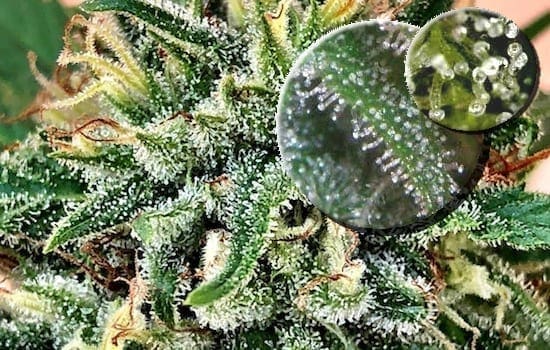
Definition: Trichomes are tiny, hair-like glands that cover cannabis flowers and nearby leaves, giving buds their frosty, sticky look. The glandular trichomes produce and store resin rich in cannabinoids like THC and CBD and aromatic terpenes. Nearly every concentrate, from kief to shatter, is a way of collecting trichomes.
What Are the Types of Trichomes?
- Capitate-stalked: the largest and most abundant on flowers, shaped like tiny mushrooms. They hold most of the plant’s cannabinoids.
- Capitate-sessile: smaller glands that sit almost flush with the surface.
- Bulbous: the smallest glandular type, scattered across the plant.
- Non-glandular: plain hairs that don’t produce resin.
Why Does the Plant Make Trichomes?
Trichomes help protect the plant. Their sticky resin and strong-smelling terpenes deter insects and grazing animals, and may help shield flowers from UV light and fungi.
How Do Growers Use Trichomes to Time Harvest?
Growers inspect trichome heads with a jeweler’s loupe or microscope. Clear heads suggest the plant isn’t ready. Cloudy, milky heads are often taken as peak potency. As more heads turn amber, many growers report a heavier, more sedating effect, though that’s based on experience rather than strong research.
How Are Trichomes Collected?
Dry sifting through fine screens produces kief, the loose powder at the bottom of a grinder. Ice water separation makes bubble hash. Heat and pressure produce rosin, and solvents dissolve trichome resin to make BHO and other concentrates.
Related terms: Terpenes, Cannabinoids, Solventless Extract, Concentrates
Sources: NIDA: Cannabis Concentrates DrugFacts; Russo EB, British Journal of Pharmacology, 2011.