CBD-Dominant Strains: Ratios, Types, and What to Know
Quick answer: CBD-dominant strains are cannabis varieties that produce much more CBD than THC, so they’re far less intoxicating. Scientists call them Type III chemovars, while Type II strains have roughly balanced THC and CBD. Commonly reported examples include ACDC, Harlequin, Charlotte’s Web, Cannatonic, and Ringo’s Gift, but ratios vary by grower and batch, so always check the lab COA.
Key takeaways
- Type I is THC-dominant, Type II is balanced, and Type III is CBD-dominant.
- THC:CBD ratio matters more than the strain name.
- Strain names aren’t standardized; the COA tells you what’s actually in the jar.
- As of October 2026, the federal hemp definition is changing to count total THC.
What are CBD-dominant strains?
Most strains sold in dispensaries are bred for high THC. CBD-dominant strains go the other direction: their main cannabinoid is CBD, with only a small amount of THC. People often choose them for a milder, clearer experience or when they want little or no high.
Some CBD-dominant plants contain so little THC that they legally count as hemp. Others carry enough THC to be regulated as marijuana, even though CBD is the main compound.
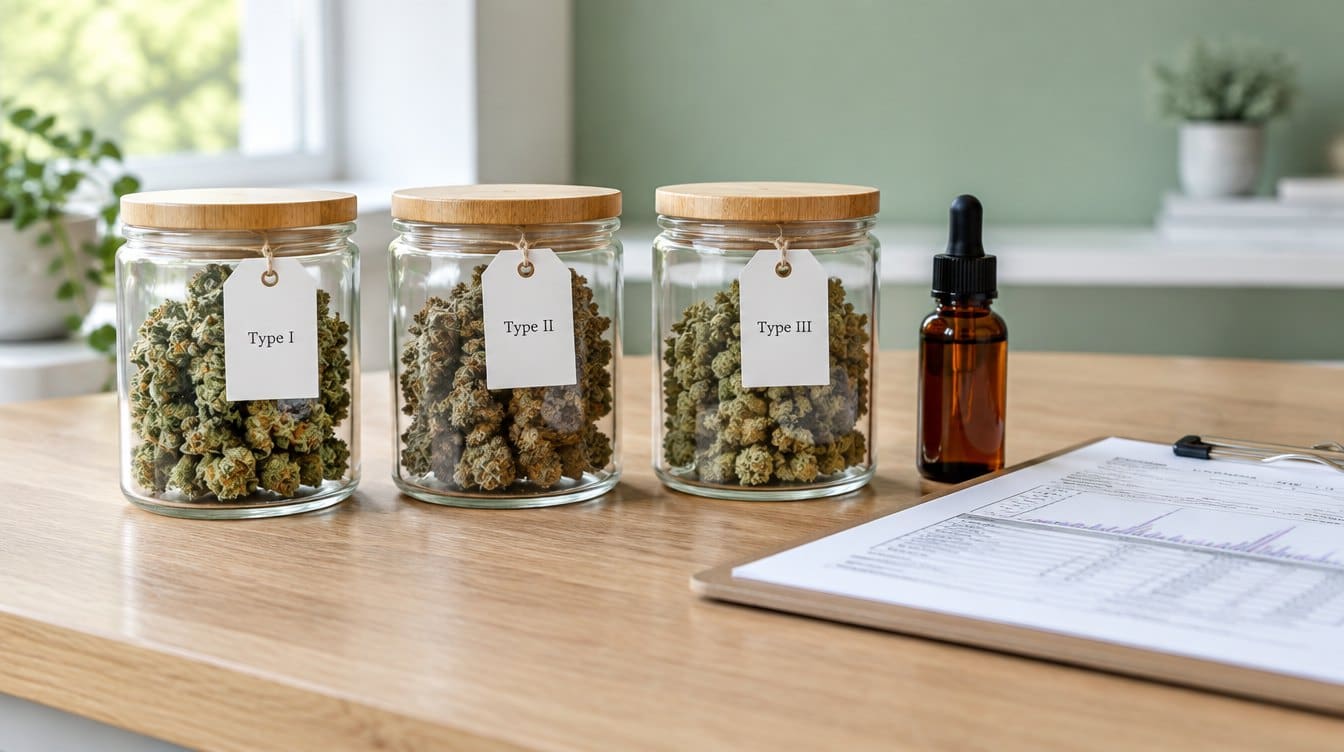
What are Type I, Type II, and Type III cannabis?
Researchers group cannabis into chemical types, or chemovars, based on the ratio of THC to CBD. The type is largely set by genetics: plants with a working gene for the THC-making enzyme produce THC, and plants with a working gene for the CBD-making enzyme produce CBD. Type II plants have both.
| Chemovar | Main cannabinoid | Typical THC:CBD pattern | What it usually feels like |
|---|---|---|---|
| Type I | THC | Much more THC than CBD | Strongly intoxicating |
| Type II | Both | Roughly balanced; one study describes CBD:THC of about 0.5:1 to 3:1 | Noticeable but often gentler high |
| Type III | CBD | Much more CBD than THC, often reported at 15:1 or higher | Little to no high for most people |
Researchers also describe rarer types dominated by other cannabinoids such as CBG, but Types I to III cover most of what you’ll see.
How do THC:CBD ratios work?
The ratio compares how much CBD a product has relative to THC. A 20:1 product has 20 parts CBD for every 1 part THC. A 1:1 product has equal amounts.
Ratios are useful, but don’t ignore the total dose. A 1:1 edible with 10 mg of THC and 10 mg of CBD still delivers 10 mg of THC, which is enough to intoxicate many people. Our edibles dosage guide explains how to calculate it.
Some research suggests CBD may soften some of THC’s side effects, like anxiety, which is one reason people prone to anxiety sometimes prefer balanced products. Evidence for this is still developing. See our guide on cannabis and anxiety for more.
Which strains are known for high CBD?
These names are commonly reported as CBD-rich. Effects described by users are anecdotal, and actual cannabinoid levels vary by grower, phenotype, and batch.
| Strain | Commonly reported type | Often reported THC:CBD | Notes |
|---|---|---|---|
| ACDC | Type III | Often reported around 1:20 | Reportedly a phenotype of Cannatonic; users often describe very little high |
| Harlequin | Type II leaning CBD | Often reported around 2:5 | Sativa-leaning; often described as clear-headed |
| Charlotte’s Web | Type III (hemp) | Very low THC, high CBD | Developed in Colorado as a hemp-type line; now also a product brand |
| Cannatonic | Type II to III | Ranges from about 1:1 to CBD-dominant | Known for variability between seeds and cuts |
| Ringo’s Gift | Type II to III | Ranges from balanced to very high CBD | Reportedly an ACDC and Harle-Tsu cross; ratio depends on phenotype |
Why should you check a COA instead of trusting the strain name?
Strain names aren’t regulated. The same name can be sold from different genetics, and even the same genetics can test differently depending on how the plant was grown and harvested. A product sold as a CBD strain could, in practice, carry more THC than you expect.
A certificate of analysis (COA) from an independent lab shows the actual numbers for that batch. Look for:
- Total THC and total CBD, which include the acid forms (THCA and CBDA) that convert when heated.
- A matching batch number and a recent test date.
- Safety testing for pesticides, heavy metals, mold, and residual solvents.
Our guide on terpenes vs. cannabinoids walks through reading a COA step by step.
What’s the difference between hemp and marijuana CBD strains?
Botanically, they’re the same plant. The difference is legal. Under the 2018 Farm Bill, hemp was defined as cannabis with no more than 0.3% delta-9 THC by dry weight. That definition didn’t count THCA, which turns into THC when smoked or vaped, so some “hemp” flower could produce a real high.
Congress changed this in November 2025. As of October 2026, the new federal definition is set to take effect on December 11, 2026, after a short-term funding bill pushed it back from November 12. Under the new rules:
- Hemp is measured by total THC, including THCA, at less than 0.3% on a dry weight basis.
- Final hemp-derived cannabinoid products are limited to 0.4 milligrams of total THC per container.
- Synthetic or lab-converted cannabinoids, such as most delta-8 THC products, are excluded from the hemp definition.
For true Type III strains, this matters less because they naturally carry very little THC. For Type II strains and THCA-rich “hemp” flower, it’s a big shift. State laws also vary, so check your state’s current rules.
Who might prefer CBD-dominant strains?
People who want to avoid a strong high, are sensitive to THC-related anxiety, or need to stay clear-headed often look at Type II or Type III options. They aren’t risk-free, though. CBD can interact with medications, including blood thinners and some seizure drugs. Read our guide on CBD drug interactions and talk to a healthcare provider if you take prescription medication.
Also note that THC can still show up on drug tests, even from CBD-dominant products.
Frequently Asked Questions
Will a CBD-dominant strain get me high?
Most people feel little or no high from Type III strains because THC levels are low. Type II strains with balanced THC and CBD can still be intoxicating, especially at higher doses. Sensitivity varies, so start with a small amount and check the COA for actual THC content.
What’s the best THC:CBD ratio for beginners?
There’s no single best ratio, but many beginners who want minimal intoxication start with CBD-dominant products such as 20:1 or 10:1. A 1:1 product produces a noticeable but often gentler high. Whatever you choose, pay attention to the total milligrams of THC, not just the ratio.
Is Charlotte’s Web a strain or a brand?
Both, in a sense. It began as a high-CBD, low-THC hemp line bred in Colorado and later became the name of a company selling CBD products. Plants or products sold under the name elsewhere may not share the same genetics, so check the COA.
Can CBD-dominant flower make me fail a drug test?
Yes, it’s possible. Even small amounts of THC can build up with regular use and be detected. Hemp flower with low delta-9 THC can still contain THCA, which converts to THC when heated. If you’re tested, CBD-dominant flower carries real risk.
Are CBD strains good for anxiety or sleep?
Research on CBD for anxiety is promising but limited, and evidence for sleep is mixed. Users often report CBD-rich strains feel calmer than high-THC strains, but that’s anecdotal. See our article on cannabis and sleep and talk to a provider about ongoing symptoms.
Sources: Murovec et al., Analysis of Morphological Traits, Cannabinoid Profiles, THCAS Gene Sequences, and Photosynthesis in High-CBD Medical Cannabis, Frontiers in Plant Science (2022); Congressional Research Service: Change to Federal Definition of Hemp and Implications for Federal Enforcement; FDA: Regulation of Cannabis and Cannabis-Derived Products, Including CBD; NCCIH: Cannabis (Marijuana) and Cannabinoids
This article is for general education and isn’t medical advice. Talk to a healthcare provider before using cannabis for a health condition.